
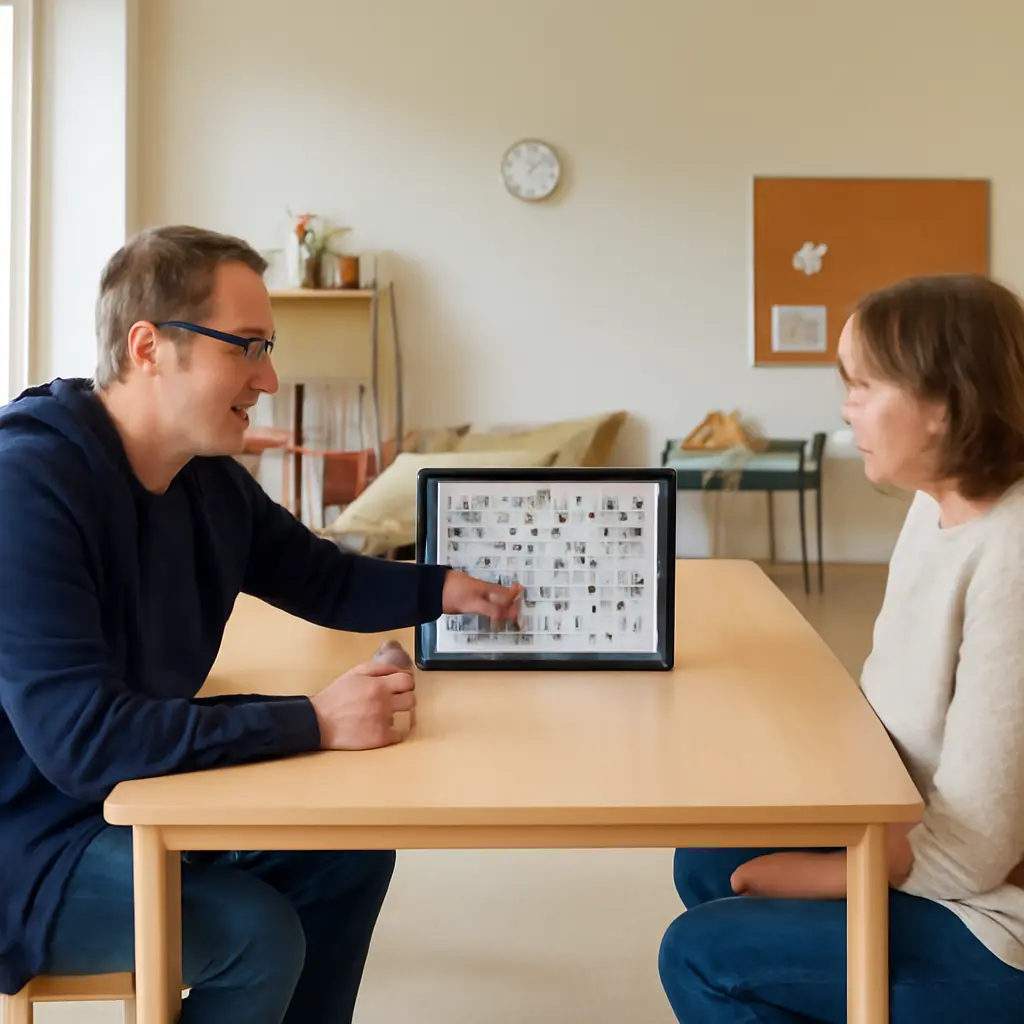
Communication support should begin when a person needs it—not after they speak. Augmentative and alternative communication (AAC) includes gestures, communication boards, signs, and speech-generating devices, and it can support communication alongside speech or when speech is not reliable. The American Speech-Language-Hearing Association (ASHA) states that there are no prerequisites for AAC. Starting support early can give children and adults more ways to express choices, ask questions, build relationships, and participate while spoken-language skills develop—or when speech is not their primary way to communicate.
Early AAC Access: Communication Support Without Waiting for Speech
What AAC means
AAC is a set of strategies and tools used to supplement or replace spoken communication. “Augmentative” means adding to speech or other communication; “alternative” means offering another way to communicate. ASHA describes AAC as including unaided methods, such as gestures and facial expressions, and aided methods, such as picture boards, alphabet displays, and speech-generating technology.
AAC is not a single device or a last resort. A person may use speech in some situations and AAC in others, or combine methods within one conversation. Access can be temporary, intermittent, or ongoing, depending on the person’s needs and circumstances.
Why waiting can restrict communication
A person does not need to prove that speech will not develop before receiving communication support. Delaying AAC can leave someone with fewer reliable ways to express pain, preferences, ideas, or refusals during the time they are waiting. It can also make participation at home, school, work, and in the community harder.
The National Joint Committee for the Communication Needs of Persons With Severe Disabilities emphasizes the right to effective communication and the importance of providing appropriate communication supports. Early access is therefore not only a matter of language learning; it is also a matter of autonomy, safety, and inclusion.
AAC Access Supports Language, Learning, and Participation
AAC does not prevent speech
A common concern is that AAC might discourage a person from speaking. Research reviews do not support that assumption. A 2006 review by Millar, Light, and Schlosser examined 23 studies involving 67 people with developmental disabilities who used AAC. Most participants showed either no change or an increase in speech production; the authors reported that AAC did not suppress speech development. These findings do not promise that AAC will produce speech, but they challenge the idea that communication tools must be withheld to protect it.
AAC provides another way to communicate when speech is unavailable, difficult to understand, or insufficient for the moment. Adults and communication partners can continue to model spoken language while also pointing to symbols, signs, or words on an AAC system. This approach treats communication methods as compatible rather than competing.
AAC gives people more ways to express themselves
Communication involves more than requesting objects. People also need to comment, ask questions, tell stories, disagree, joke, greet others, and share feelings. A system limited to a few requests may not support these broader purposes. A useful AAC plan should allow the person to communicate across settings, partners, and topics, with vocabulary that can grow as their interests and skills change.
The World Health Organization and UNICEF reported in their 2023 Global Report on Assistive Technology that more than 2.5 billion people need one or more assistive products, while nearly one billion lack access. This global estimate covers assistive technology broadly—not AAC alone—but it illustrates the scale of unmet need and why access should not depend on a person’s ability to speak.
AAC supports learning and everyday participation
With reliable communication access, a learner can answer, request clarification, contribute an idea, and show what they know without being limited to spoken responses. At home, a person can make choices or communicate discomfort; in healthcare, they can share symptoms and preferences; in community life, they can take part in conversations. These outcomes depend not just on having a tool, but on having a usable system and communication partners who make room for it.
AAC Options Match Different People and Situations
Unaided communication
Unaided AAC uses the body rather than an external device. It can include gestures, facial expressions, body movements, manual signs, and conventional signals such as nodding. These methods are immediately available, but their usefulness depends on whether communication partners can recognize and interpret them. They may also be difficult for some people to use consistently or clearly.
Low-tech and paper-based supports
Low-tech AAC includes communication boards, picture cards, alphabet charts, and written choices. These tools do not require batteries or internet access and can be prepared for specific activities, such as a medical appointment or classroom routine. They should not be treated as merely temporary if they meet the person’s needs; they can also complement electronic systems.
Speech-generating devices and apps
High-tech AAC includes dedicated speech-generating devices and software on tablets or other computers. A person may select symbols, type words, or combine both to produce spoken output. The right option depends on the individual’s access method, vision, motor skills, language, environments, preferences, and support needs—not on assumptions about diagnosis or age.
A multimodal system
Multimodal communication means using more than one method, such as speech with gestures, a communication board, and a device. A person’s most effective method may vary with noise, fatigue, stress, the conversation partner, or the urgency of the message. Keeping multiple options available can make communication more flexible and resilient.
AAC Works Best When Support Begins Early and Follows the Person
Start with communication needs, not prerequisites
ASHA advises that there are no prerequisites for AAC. A person does not have to demonstrate a particular level of cognition, cause-and-effect understanding, symbol recognition, or readiness before AAC is considered. Assessment should instead identify communication goals, strengths, access needs, languages, environments, and the person’s preferences. A speech-language pathologist can help assess and plan support, collaborating with the person, family, educators, clinicians, and other relevant partners.
Provide communication opportunities throughout the day
An AAC system is useful only when it is available and communication partners respond to it. Keep the person’s system accessible during ordinary routines, not only during therapy or lessons. Give enough time for a response, acknowledge all intentional communication, and avoid requiring a person to use speech when they are communicating successfully another way.
Model AAC without demanding imitation
A communication partner can model AAC by selecting a word or symbol while speaking, much as a language partner naturally demonstrates words in conversation. Modeling helps show how the system works and where vocabulary is located. It should be an invitation, not a test: the person should not have to copy a model before receiving what they need or being included in an activity.
Review and adapt the system
Communication needs can change with development, health, education, work, and daily life. Review whether the vocabulary is useful, whether the person can access it reliably, and whether partners know how to support communication. If a method is difficult to use, adjust the system or explore alternatives rather than concluding that the person is not ready to communicate.
Conclusion: Make Communication Support Available Now
AAC includes unaided communication, low-tech supports, speech-generating technology, and combinations of methods. ASHA’s guidance that there are no prerequisites, together with research finding no evidence that AAC suppresses speech, supports a practical principle: do not make access to communication conditional on spoken-language progress. Early, individualized support can expand opportunities to express needs and ideas, participate in learning, and exercise autonomy.
Families, educators, clinicians, and service providers can start by asking what the person needs to communicate today, making communication tools available, and learning how to respond to every communication mode. For individualized planning, consult a qualified speech-language pathologist and involve the person who will use the system in every decision.
Sources: American Speech-Language-Hearing Association, Augmentative and Alternative Communication (AAC), https://www.asha.org/public/speech/disorders/aac/; American Speech-Language-Hearing Association, Augmentative and Alternative Communication, Practice Portal, https://www.asha.org/practice-portal/professional-issues/augmentative-and-alternative-communication/; Millar, D. C., Light, J. C., and Schlosser, R. W., “The Impact of Augmentative and Alternative Communication Intervention on the Speech Production of Individuals With Developmental Disabilities: A Research Review,” Journal of Speech, Language, and Hearing Research, 2006, https://doi.org/10.1044/1092-4388(2006/021); National Joint Committee for the Communication Needs of Persons With Severe Disabilities, Communication Bill of Rights, https://www.asha.org/siteassets/uploadedfiles/njc-communication-bill-rights.pdf; World Health Organization and UNICEF, Global Report on Assistive Technology, 2022, https://www.who.int/publications/i/item/9789240049451.