
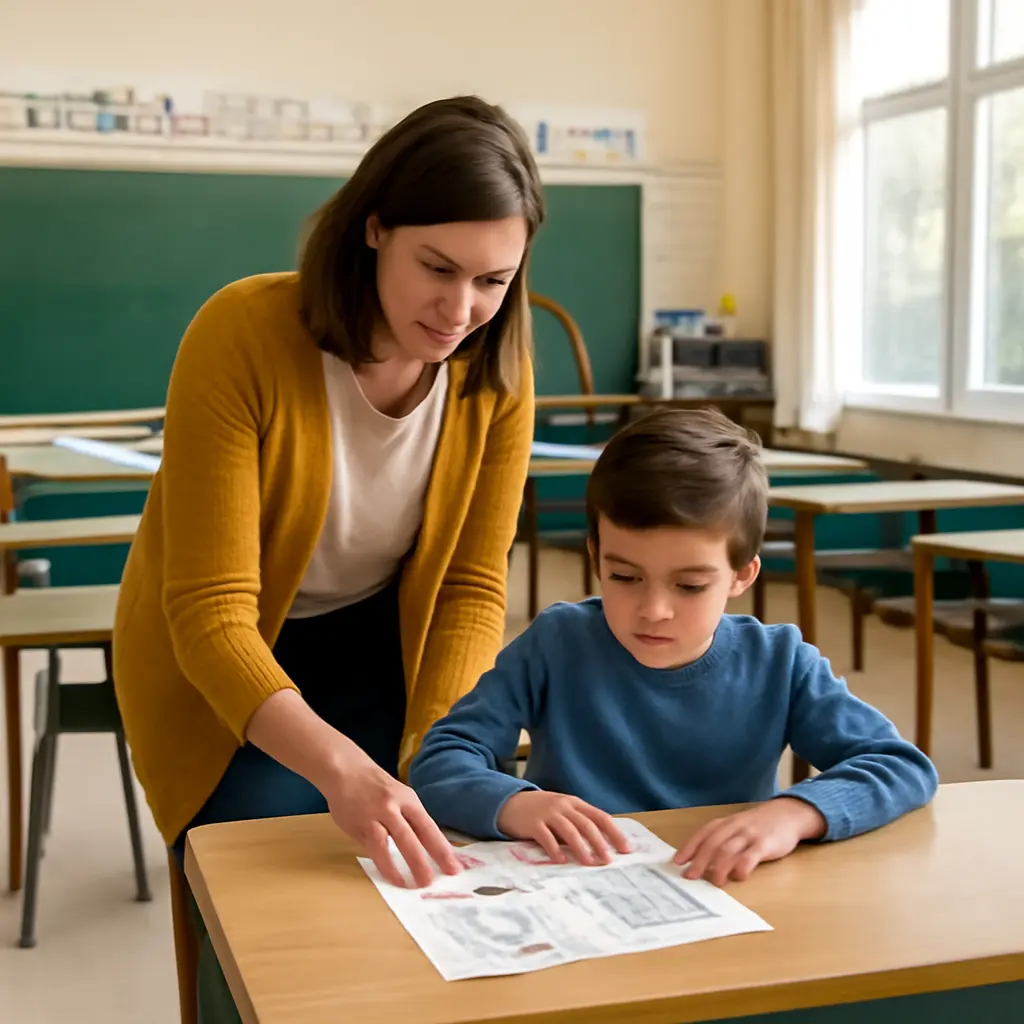
Speech and behavior concerns in school-age children can overlap, but they are not the same thing. Speech-language support addresses difficulties producing or understanding communication; behavioral support investigates actions, emotions, and the situations that influence them. Because communication difficulties can contribute to frustration or classroom conflict—and behavioral, developmental, or emotional needs can affect communication—families and schools should assess the child’s skills and circumstances rather than assume one explanation. The distinction matters: the National Institute on Deafness and Other Communication Disorders estimates that about 1 in 12 U.S. children ages 3–17 had a disorder related to voice, speech, language, or swallowing in 2012, while the U.S. Centers for Disease Control and Prevention reports that about 1 in 6 children ages 3–17 had a developmental disability in 2009–2017. These are different measures from different periods, not directly comparable estimates, but they underscore why individualized assessment and coordinated support matter.
Speech and Behavior: How to Choose Support for School-Age Kids
Identifying Speech and Behavior Support Needs
A useful starting point is to define what each kind of support is intended to address. The American Speech-Language-Hearing Association (ASHA) describes speech-language pathologists as professionals who assess and treat speech, language, social communication, and related communication difficulties. Behavioral support, by contrast, focuses on observable actions and the conditions around them, such as what happens before and after a behavior, what purpose it may serve, and which skills or environmental changes could help.
These categories are not mutually exclusive. A child who cannot reliably explain confusion, ask for help, or follow spoken instructions may show distress or avoid work. That pattern does not prove a speech or language disorder, and a communication difficulty does not explain every behavioral concern. Schools and families should look for evidence across settings, consider the child’s developmental and cultural context, and seek appropriate assessment before drawing conclusions.
Speech, Language, and Social Communication
Speech refers to producing sounds; language concerns understanding and using words, sentences, and meaning; social communication involves using communication effectively with other people and in different situations. These distinctions matter because a child may speak clearly yet struggle to understand complex directions, tell a coherent story, or participate in conversation. ASHA identifies speech-language pathologists as qualified to evaluate these areas and recommend intervention when needed.
Possible signs for discussion with a professional include persistent difficulty being understood, following age-appropriate directions, finding words, explaining ideas, reading or spelling, or taking conversational turns. These signs are reasons to ask questions, not a diagnosis. Hearing, language exposure, learning differences, and other factors may also affect communication. A hearing evaluation may be part of the assessment when listening or speech concerns arise.
Behavior as an Observable Pattern
Behavioral support begins with describing what a child does in specific terms rather than applying labels such as “defiant” or “attention-seeking.” For example, a team might record that a student leaves their seat during independent writing, note what happened immediately beforehand, and identify what follows. This helps distinguish a recurring pattern from an isolated event and points toward possible supports, such as clearer instructions, a break, help with the task, or explicit teaching of a replacement skill.
The U.S. Department of Education’s guidance on positive behavioral interventions and supports emphasizes proactive, individualized approaches. In schools, a functional behavioral assessment may be considered when a team needs to understand why a behavior occurs and develop effective supports. Such assessment should not be reduced to punishment or a search for blame: it should examine context, access to instruction, communication needs, and relevant student strengths.
Why the Two Can Overlap
Communication and behavior influence each other. A child who has trouble processing spoken language may miss a direction; a child who cannot express pain, confusion, or a need for help may communicate distress through actions. Conversely, anxiety, attention difficulties, sensory demands, or classroom stress can affect how a child speaks, listens, and participates. The American Academy of Pediatrics’ clinical guidance on developmental surveillance and screening supports ongoing attention to development and referral when concerns arise, rather than waiting for difficulties to resolve on their own.
Choosing the Right Assessment and Support
Once a concern is noticed, the next step is to gather information about what the child can do, where difficulties occur, and what helps. A teacher’s observations, family input, the child’s perspective, work samples, and a professional evaluation can reveal different parts of the picture. The goal is not to decide whether a child is “speech” or “behavior”; it is to identify the needs affecting learning, participation, and well-being.
When to Seek a Speech-Language Evaluation
Consider asking a pediatrician or school team about a speech-language evaluation when communication difficulties persist or interfere with classroom learning, relationships, or daily activities. A speech-language pathologist may assess speech sounds, receptive and expressive language, fluency, voice, social communication, or related skills, depending on the concern. If the child struggles to hear or respond to spoken language, ask whether hearing should also be checked.
In the United States, families can request an evaluation from their public school when they suspect a disability is affecting educational access or progress. Under the Individuals with Disabilities Education Act (IDEA), eligible students may receive special education and related services, including speech-language services when required for the child to benefit from special education. Eligibility and service decisions are made through the applicable evaluation and team process; a diagnosis alone does not automatically determine a particular school service.
When to Explore Behavioral or Emotional Support
Behavioral support may be appropriate when a pattern repeatedly interferes with learning, safety, relationships, or participation. Start by documenting observable details: what the child did, the setting, what occurred beforehand, how adults and peers responded, and whether the pattern changes across tasks or environments. Share this information with the teacher, school psychologist, counselor, pediatrician, or other appropriate professional.
A school team may use positive behavioral interventions, classroom adjustments, counseling, or a functional behavioral assessment depending on the student’s needs and applicable procedures. The Centers for Disease Control and Prevention advises families to discuss developmental or behavioral concerns with a child’s health care provider and notes that developmental monitoring and screening can help identify concerns. Seek urgent professional help if a child’s behavior creates an immediate risk of harm.
Questions That Help Separate—and Connect—the Concerns
Rather than trying to diagnose a child at home or in the classroom, use practical questions to guide discussion:
- Does the difficulty mainly involve being understood, understanding others, finding words, or taking part in conversation?
- Does the behavior occur during particular communication demands, transitions, subjects, social situations, or times of day?
- Can the child explain what they need, ask for clarification, and request a break in a way that works for them?
- What changes when instructions are shortened, written down, demonstrated, or paired with visual support?
- Do the same concerns appear at home, school, and in other settings, or are they limited to one environment?
- What does the child say about the situation, and what strengths or interests can support progress?
For example, imagine a student who leaves their seat whenever the class begins a lengthy writing task. If the student also struggles to understand the prompt or organize spoken explanations, the team might examine language and learning demands alongside the behavior pattern. The team could trial shorter directions, a visual checklist, opportunities to dictate ideas, and planned breaks, then track whether participation improves. This is an illustrative example, not a substitute for individual assessment.
Coordinating Support at School and at Home
The strongest plan connects assessment findings to daily routines. Families and educators can agree on a small number of specific goals, decide who will provide each support, and check whether the plan helps. For a communication goal, progress might mean that the student asks for clarification using an agreed method. For a behavior goal, it might mean increasing time engaged in a task or using a taught request instead of leaving the room. Measures should reflect meaningful participation, not simply compliance.
Use Consistent, Accessible Communication
Teachers and caregivers can support communication by using clear language, allowing processing time, checking understanding without embarrassment, and offering visuals or written directions where useful. A child who communicates using an augmentative or alternative communication system should have access to it across relevant settings. ASHA recognizes augmentative and alternative communication as a means of supporting communication for people with complex communication needs; using such support does not require waiting until a child has exhausted other approaches.
Teach Skills and Adjust the Environment
Effective plans commonly combine teaching with environmental changes. A child may need direct instruction in asking for help, interpreting figurative language, organizing a response, or moving between activities. At the same time, adults can reduce unnecessary barriers by making routines predictable, breaking complex tasks into steps, and matching directions to the child’s communication needs. Reinforcing a useful replacement behavior is generally more informative than relying only on consequences after a problem occurs.
Review Progress and Adjust the Plan
Review the plan after a reasonable period using observations and data tied to its goals. Ask whether the child is communicating more successfully, accessing instruction, feeling safer, or participating more fully. If progress is limited, the team should reconsider whether the assessment captured the relevant need, whether supports are being delivered consistently, and whether other factors—such as hearing, learning, health, sleep, stress, or classroom fit—need attention. Families can request a meeting with the school team to discuss concerns and next steps.
Conclusion: Match Support to the Child, Not a Label
Speech-language needs concern communication skills; behavioral needs concern patterns of action and the conditions that shape them. Because communication barriers can contribute to distress and other needs can affect participation, the two may overlap. Clear observations, professional evaluation, the child’s perspective, and coordinated school-home support help teams choose appropriate next steps without assuming a cause from a behavior alone.
If a concern is affecting a child’s learning, relationships, or well-being, write down specific examples and discuss them with the child’s teacher, pediatrician, or school support team. Ask what assessment is appropriate, what supports can begin now, and how progress will be reviewed. Early, individualized support can help children communicate, learn, and participate more confidently.
Sources: National Institute on Deafness and Other Communication Disorders, “Quick Statistics About Voice, Speech, Language,” https://www.nidcd.nih.gov/health/statistics/quick-statistics-voice-speech-language; Centers for Disease Control and Prevention, “Developmental Disabilities,” https://www.cdc.gov/ncbddd/developmentaldisabilities/features/increase-in-developmental-disabilities.html; American Speech-Language-Hearing Association, “Speech-Language Pathologists,” https://www.asha.org/public/who-are-speech-language-pathologists/; U.S. Department of Education, “Dear Colleague Letter on Ensuring Equity and Providing Behavioral Supports to Students with Disabilities,” https://www.ed.gov/laws-and-policy/key-policy-letters/dear-colleague-letter-on-ensuring-equity-and-providing-behavioral-supports-to-students-with-disabilities; American Academy of Pediatrics, “Promoting Optimal Development: Identifying Infants and Young Children With Developmental Disorders Through Developmental Surveillance and Screening,” https://publications.aap.org/pediatrics/article/145/1/e20193449/36917/Promoting-Optimal-Development-Identifying-Infants; U.S. Department of Education, Individuals with Disabilities Education Act, “Sec. 300.34 Related Services,” https://sites.ed.gov/idea/regs/b/a/300.34; Centers for Disease Control and Prevention, “Concerned About Your Child’s Development?” https://www.cdc.gov/ncbddd/actearly/concerned.html; American Speech-Language-Hearing Association, “Augmentative and Alternative Communication (AAC),” https://www.asha.org/public/speech/disorders/aac/